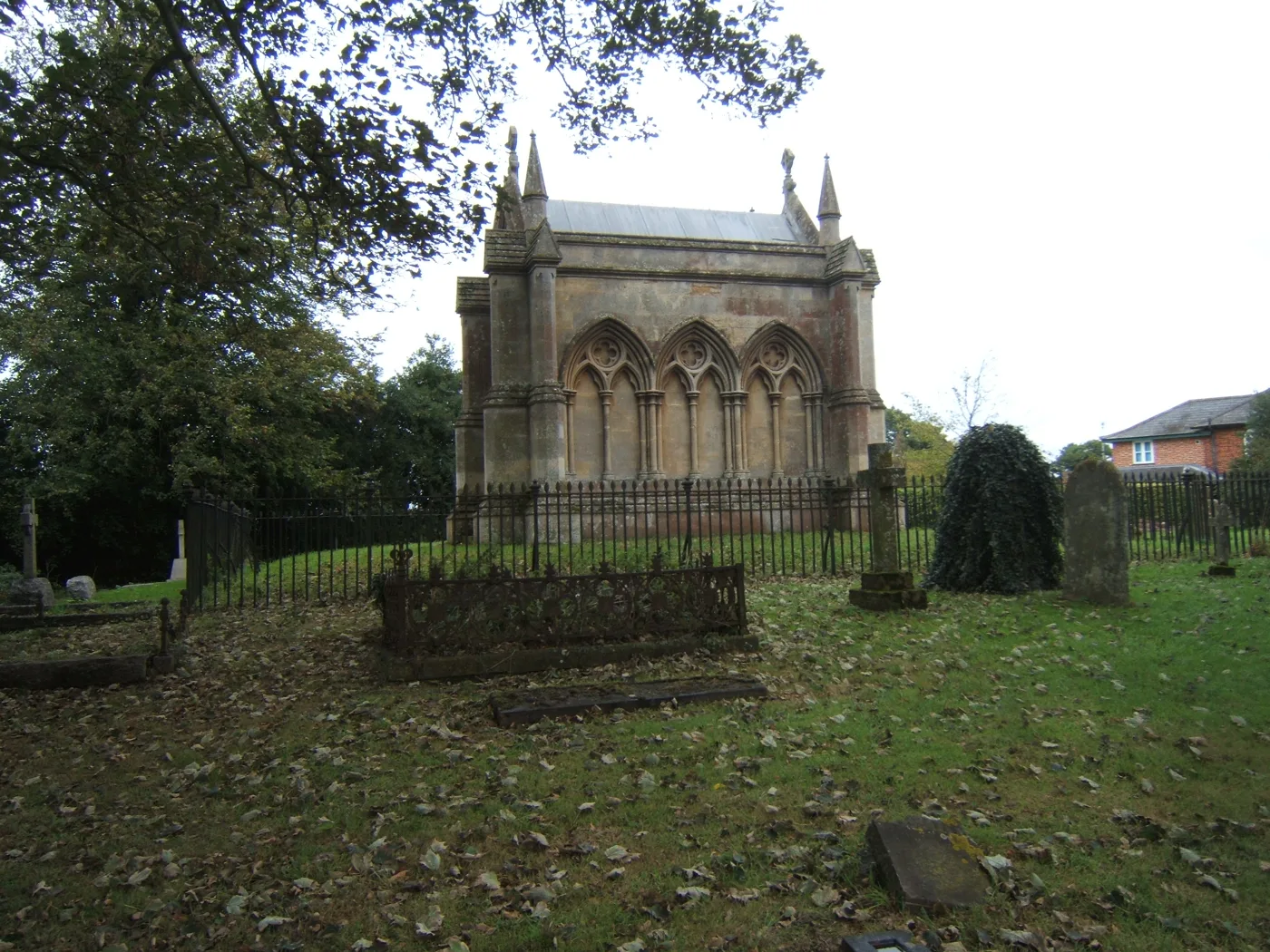

Historic England raised the Trafford Mausoleum to Grade II* on 17 July, the only one of Broadland's 1,021 listed buildings amended this year. What tipped it.
The Trafford Mausoleum in Wroxham has been upgraded from Grade II to Grade II on the National Heritage List for England. The amendment was made on 17 July 2026* and Broadland District Council announced it on 14 August.
It is the only one of the district’s 1,021 listed building entries to have been amended at all this year.
The upgrade followed a reassessment by Historic England, which the council asked for. The original entry dated from 16 May 1984 and had never been revised. The new one runs to well over a thousand words and, for the first time, describes what is inside.
Why it went up a grade
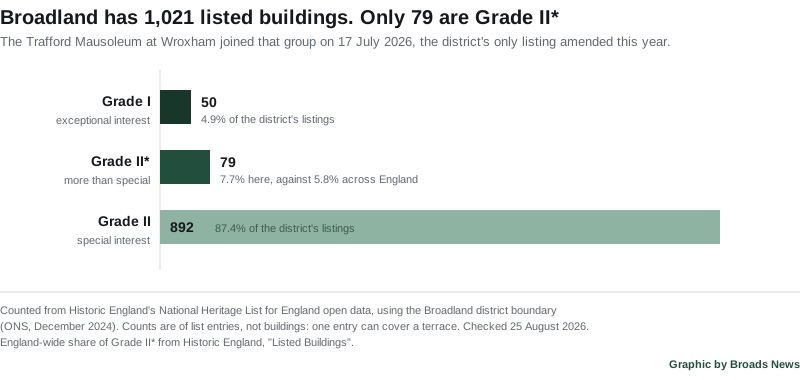
Grade II is the middle of the three grades and it is not common. Historic England puts it at around 5.8% of listed buildings* nationally, against 2.5% for Grade I and 91.7% for Grade II.
In Broadland the picture is slightly heavier at the top. Counted from Historic England’s own open data against the district boundary, the 1,021 entries break down as 50 Grade I, 79 Grade II* and 892 Grade II.
The list entry gives five reasons for the upgrade, under three headings (Historic England, list entry 1050869):
- as the first completed ecclesiastical work of Anthony Salvin (1799-1881)
- as an accomplished early work of the Gothic Revival, using what the entry calls “a scholarly use of Early English Gothic”
- for the quality of the interior: carved stonework, gilded and painted roof bosses, heraldic motifs and memorial plaques
- as a rare Roman Catholic mausoleum in an Anglican churchyard, with a design that predates the Roman Catholic Relief Act 1829
- for its group value with the Grade I Church of St Mary and the Grade II former sexton’s house, now Church Cottage
The interior nobody had assessed
The 1984 entry did not cover the inside. The 2026 one does, and it reads like the part that settled the argument.
The single room has blind arcading on every wall. The arches spring from bell-moulded capitals on the north and south sides and from stiff-leaf capitals on the east wall, and they are banded with dogtooth moulding. Memorial panels in brass and stone sit inside many of the arches.
Above that is a wooden wagon vault with roll-moulded ribs and gilded and painted bosses. The bosses are cast lead, and they carry cinquefoils and leopard masks taken from the Southwell and Crowe family arms. The oculus at the east end has armorial stained glass.
Two things have changed since it was built. The entrance to the burial vault below was closed around the year 2000, and a stone altar in a Gothic Revival style was built above it. Otherwise the entry describes the building as remarkably intact.
Who built it, and why
The mausoleum was commissioned by Margaret Trafford Southwell after the death of her husband, Sigismund Trafford Southwell, in 1827.
The design was finished by March 1828, when a Faculty was obtained for the work. The building was complete by 1830. A model of it was shown at the Royal Academy that year, and the Gentleman’s Magazine described it as “a pleasing and exquisite miniature chapel, architecture the style of Westminster Abbey”.
The religious point matters. This is a Roman Catholic burial chapel standing in the churchyard of a working Anglican parish church, and it was designed before the Catholic Relief Act of 1829 removed most of the legal disabilities on Catholics in England. Historic England calls that rare, and it is one of the five reasons given for the upgrade.
Anthony Salvin started here
The architect was 28 or thereabouts when he took the commission, and this was his first executed church work.
Anthony Salvin went on to a career that shows up all over the listed building register. The entry records that he designed 36 new churches that are now listed, ten of them at Grade II* and one at Grade I. He worked on Windsor Castle and the Tower of London, both scheduled monuments, and he refaced Norwich Castle. He was awarded the Royal Gold Medal of the Royal Institute of British Architects in 1863.
Three architects who trained in his office, his nephew W.E. Nesfield, R. Norman Shaw and J.L. Pearson, went on to careers of their own. The Wroxham mausoleum is where the run started.
What it means for you
If you were hoping to look inside, you probably cannot. Historic England is explicit that most places on the list are not open to the public. The mausoleum stands in the churchyard of St Mary’s, St Mary’s Close, Wroxham, NR12 8SG, and it is enclosed by its own wrought iron gates and railings, which are covered by the listing too.
If you own or look after a listed building, the grade is not what triggers the paperwork. Listed building consent is needed for works that affect the special interest of any listed building, at every grade, inside and out. Historic England notes that carrying out works without that consent is a criminal offence. What the grade changes is the weight a planning authority gives to harm when it decides.
If you are curious what else near you is listed, the National Heritage List is free to search and each entry carries the same official text, licensed for reuse under the Open Government Licence. Broadland has 1,021 of them, and this is the only entry that has changed in 2026.
Sources
- Historic England, National Heritage List for England, list entry 1050869: Trafford Mausoleum with gates and railings, St Mary’s Churchyard, Wroxham, Grade II*, first listed 16 May 1984, most recent amendment 17 July 2026. Official list entry text is available under the Open Government Licence v3.0.
- Broadland District Council: Historic Mausoleum upgraded to Grade II*, published 14 August 2026, for the council’s request for the reassessment.
- Historic England: Listed Buildings for the grade definitions, the national shares and the consent rules.
- Grade counts for Broadland calculated on 25 August 2026 from the National Heritage List for England open data (Listed Building points), filtered to the Broadland district boundary published by the Office for National Statistics (Local Authority Districts, December 2024). Counts are of list entries, not individual buildings.
Have your say