
Broadland had 96 households in temporary accommodation in March, up from 64 in June 2025. Cabinet is asked on 20 October to adopt a plan to bring it down.
Broadland District Council had 96 households in temporary accommodation on 31 March 2026. Nine months earlier the figure was 64. That is a rise of half.
The numbers come from the government’s own quarterly homelessness tables. They land as the council’s Cabinet is asked, on Tuesday 20 October, to adopt a new Homelessness Action Plan with targets to 2028 (Broadland Cabinet agenda, 20 October 2026).
The figures
The government’s table TA1 counts the households a council has placed in temporary accommodation on the last day of each quarter. For Broadland it shows:
| Date | Households in temporary accommodation | Of which with children | Children |
|---|---|---|---|
| 30 June 2025 | 64 | 24 | 35 |
| 30 September 2025 | 76 | 25 | 34 |
| 31 December 2025 | 94 | 21 | 37 |
| 31 March 2026 | 96 | 21 | 46 |
(MHCLG, Statutory homelessness: detailed local authority-level tables, table TA1, for each quarter. The 2025 quarters are revised figures; March 2026 is the first release and may be revised.)
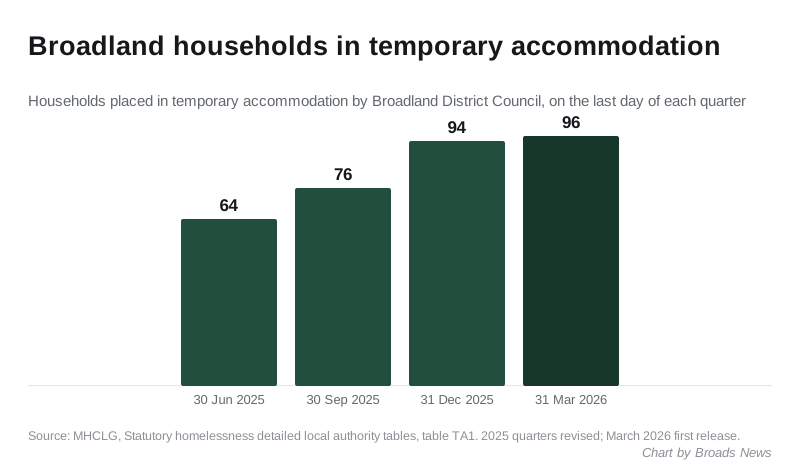
The whole rise is in households without children. Families with children went from 24 to 21 over the same nine months. The number of children in those families went up, from 35 to 46.
On 31 March, the 96 households were in:
- council or housing association homes: 65
- nightly paid, privately managed rooms or flats: 23
- hostels: 6
- bed and breakfast: 1
Another 23 households were owed temporary accommodation but were still in their existing home or making their own arrangements, which the tables call “homeless at home”. Fourteen of them had children (MHCLG, table TA1, 31 March 2026).
Most are placed outside Broadland
The same table records 79 Broadland households as out of area on 31 March, owed temporary accommodation in another council’s district. Its notes warn that this count can include households owed a duty but not yet housed, so it is not a straight share of the 96.
The council’s placement policy explains why the number is high. It says the preference is for council-owned homes inside the district, but availability is limited. It lists the other options as:
- homes owned by Broadland District Council in the Norwich City area
- homes owned by South Norfolk Council, in South Norfolk or in Norwich
- spot-purchased rooms, inside the district where possible and outside it when not
(Broadland Temporary Accommodation Placement Policy, October 2026, Cabinet papers item 7.)
The policy sets out who gets priority for a place inside Broadland. That includes a child sitting exams at a school in the district, a child with special educational needs being taught here, and someone providing long-standing care to a relative in the district.
How Broadland compares
Per 1,000 households, Broadland’s rate on 31 March was 1.55. That is level with Great Yarmouth for the highest in Norfolk, and well below the average for England outside London, which was 2.83.
| Council | Households in temporary accommodation | Per 1,000 households |
|---|---|---|
| Great Yarmouth | 71 | 1.55 |
| Broadland | 96 | 1.55 |
| Breckland | 79 | 1.22 |
| South Norfolk | 80 | 1.18 |
| North Norfolk | 55 | 1.08 |
| Norwich | 60 | 0.90 |
| King’s Lynn and West Norfolk | 34 | 0.48 |
(MHCLG, table TA1, 31 March 2026. Great Yarmouth’s unrounded rate is very slightly higher than Broadland’s.)
What the new plan promises
Every council has to publish a Homelessness Action Plan by this autumn, under the government’s National Plan to End Homelessness. The plans are a condition of a new homelessness grant (Cabinet report, Broadland Homelessness Action Plan 2025 to 2030).
Broadland’s plan sets these targets for autumn 2028:
- households with children in temporary accommodation: down from 0.41 per 1,000 households in September 2025 to 0.25
- families with children in bed and breakfast for more than six weeks: kept at zero
- share of homelessness cases prevented or relieved: up from 41% to 50%. The government expects better than 46.5%
- people sleeping rough on a single night: from one in November 2025 to zero by November 2027
The number of people sleeping rough long term over a month was zero in November 2025, and the target is to keep it there.
One figure in the plan does not match the government’s count. It describes the 0.41 baseline as “equivalent to 57 households”, and the 0.25 target as equivalent to 35. The government’s table for 30 September 2025 records 25 Broadland households with children in temporary accommodation, which is what 0.41 per 1,000 works out at. On the same basis the 2028 target would be about 15 families.
The council says the plan’s actions will be met from existing staff and money, with a business case for anything that needs more.
What it means for you
If you are at risk of losing your home, the council’s duty to help starts when you are likely to become homeless within 56 days (Homelessness Reduction Act 2017, section 1). Contacting the housing team early gives it the best chance of preventing it. The council’s plan rests on doing more of that prevention work, and its own measure says 89% of its interventions to prevent homelessness succeeded in July to September 2025.
If you are offered temporary accommodation, the policy says you will get one offer. If you turn it down and the council judges it suitable, it does not have to make another. You can ask for a review of the suitability of longer-term temporary accommodation, but not of the interim place offered while your case is looked into.
The policy also says a family with a child sitting exams, or a child with special educational needs taught locally, should be prioritised for a place inside Broadland. If that applies to you, tell the housing officer at the start.
The Cabinet meets at 6pm on Tuesday 20 October in the Upper Yare room at the Horizon Centre, Peachman Way, NR7 0WF, and the papers are online now. More on housing in the district: the shortage of one-bedroom homes in Broadland and Broadland council tax bands.
Sources
- MHCLG, Statutory homelessness: live tables: detailed local authority tables for April to June 2025, July to September 2025 and October to December 2025 (all revised) and January to March 2026, table TA1.
- Broadland Cabinet, 20 October 2026, agenda and reports: item 7, the Homelessness Action Plan 2025 to 2030 report, the action plan (appendix 1) and the Temporary Accommodation Placement Policy (appendix 2).
Have your say