
Acle's rewritten plan must go to a village vote, the examiner has ruled. Its 23 new green spaces tipped it over, and a developer wants three views deleted.
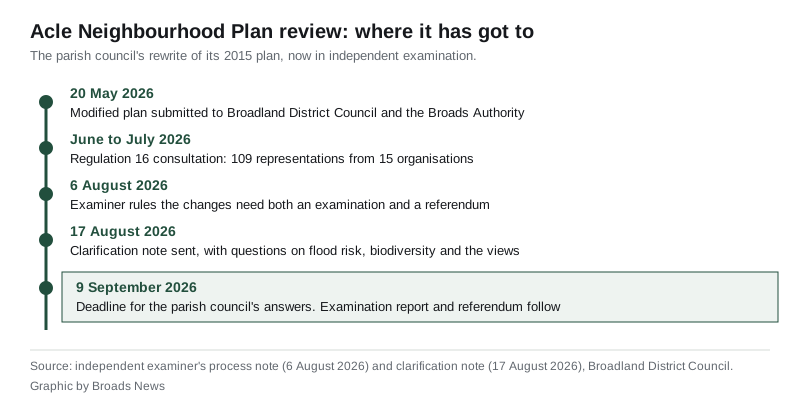
Acle’s rewritten neighbourhood plan will have to be put to a village referendum before it can take effect. The independent examiner appointed to look at it, Andrew Ashcroft, ruled on 6 August that the parish council’s changes are so substantial that they change the nature of the plan.
That is the highest of the three routes a plan review can take, and it is not what the parish council had argued for.
The examiner followed up on 17 August with a list of questions for the parish council, and asked for answers by 9 September. Both documents are now published on the district council’s website.
Why a referendum, and why it matters
A neighbourhood plan can be modified three ways. Minor corrections need neither an examination nor a vote. Material changes that do not alter the plan’s nature need an examination only. Changes that do alter its nature need both an examination and a referendum.
In its submission the parish council said the modifications were not so significant as to change the plan’s nature. Broadland District Council disagreed, and the examiner has now agreed with the district council.
He gave two reasons in his process note:
- the cumulative effect of the plan’s new policies, ACLE10 to ACLE16
- the specific effect of the proposed package of Local Green Spaces in Policy ACLE12
The district council’s own representation sets out the scale of the rewrite. Two policies from the 2015 plan have been deleted and the remaining nine modified. Nine new policies have been added, which is more than half the policy content of the new document. Most of the new material covers the natural environment and landscape, which the 2015 plan did not address at all.
The plan runs to 2040, matching the end date of the Greater Norwich Local Plan.
The 23 green spaces
Policy ACLE12 would designate 23 Local Green Spaces in the parish. There were none in the 2015 plan. It is a strong designation, and a demanding one to justify: government guidance says a Local Green Space may be designated only where the land is demonstrably special to the local community.
Norfolk County Council’s lead local flood authority confirmed the figure of 23 in its representation. The county council also objected in a different capacity. As highway authority it says the plan would designate stretches of adopted highway verge as green space, and that verges do not meet the national test of being demonstrably special. It asked for the boundaries on Figure 24 to be redrawn to exclude public highway.
The three views a developer wants deleted
The sharpest objection concerns Policy ACLE14, which protects a set of important public views.
Views A, B and C look out over land west of Acle, north of Norwich Road and south of South Walsham Road. The Greater Norwich Local Plan has already allocated that land for housing as site B.AC.1: 25.5 hectares and around 340 homes.
Representations submitted by Bidwells on behalf of Repton Property Developments and Lovell Homes ask for views A, B and C to be deleted from the policy and the proposals map. Their argument is that the stated reasons for choosing the views rest on the open nature of the fields. On that reading, a scheme that satisfied the housing allocation could not also comply with the view policy.
Repton is a property company owned by Norfolk County Council. Its representation says it owns the land between Mill Lane and Norwich Road, roughly half of allocation B.AC.1, and has partnered with Lovell Homes to bring the site forward.
The examiner has picked the point up. In his clarification note he asks the parish council to comment on “the potential impact of the identification of the views on the number of homes that would be delivered on the allocated site”.
Acle has three residential allocations in the Greater Norwich Local Plan.
| Site | Land | Size | Homes |
|---|---|---|---|
| B.AC.1 | West of Acle, north of Norwich Road, south of South Walsham Road | 25.5 ha | about 340 |
| B.AC.2 | North of Norwich Road | 5.6 ha | about 140 |
| B.AC.3 | South of Acle station | 2.0 ha | about 30, plus employment space |
What the examiner thinks of the plan
His clarification note is not hostile. He calls the document “an excellent review of a made Plan”. He singles out three things:
- the maps and photographs, which he calls excellent
- Figure 13, which sets out how the vision, the objectives and the policies fit together
- Policy ACLE1 on the design of new development, “a first-class response” to the design chapter of national planning policy
He does flag two policies as drawn too broadly:
- ACLE10, flood risk. He is minded to recommend changes so the policy takes a proportionate approach, because as written it would bear on the minor and domestic applications that make up most of Acle’s planning caseload.
- ACLE13, biodiversity. Same objection to the first part of the policy.
He has also asked the parish council to reply to four sets of comments in particular:
- Repton Property Developments
- Norfolk Fire and Rescue Service
- Anglian Water
- the revisions proposed by Broadland District Council and by the Broads Authority
Who commented
The Regulation 16 consultation ran between June and July. It produced 109 individual representations, and every one came from an organisation or statutory body rather than a resident. The 15 respondents were led by Broadland District Council and the Broads Authority with 21 representations each, then The Broads Society with 13 and Bidwells with 11.
Acle sits partly inside the Broads, so the plan was submitted to the Broads Authority as well as to Broadland District Council, and both are planning authorities for it.
What happens next
- by 9 September: the parish council answers the examiner’s questions, sending responses through the district council
- after that: the examiner decides whether a hearing is needed. Most neighbourhood plan examinations proceed on written representations alone
- then: a fact-check report to the parish council, the district council and the Broads Authority, followed by the examination report
- finally: a referendum in the neighbourhood area, which the district council organises
The examiner has also asked the parish council to confirm whether it wants to carry on with the review at all, now that a referendum is required. It can withdraw instead.
What it means for you
If you live in Acle, you will get a vote on this plan, which you would not have done had the examiner ruled the other way. A neighbourhood plan that passes its referendum becomes part of the development plan, which means planning officers have to take it into account on every application in the parish.
The plan does not stop the 510 homes already allocated in the Greater Norwich Local Plan. It sets the terms: design codes, protected views, green spaces, tree and hedge rules, and where new housing should go. That is what the argument over views A, B and C is really about.
Every document in the examination, including the full submission plan and the representations, is on the district council’s Acle Neighbourhood Plan Review page.
We track applications across the district on our Broadland planning news page.
Sources
- Independent examiner’s process note, Andrew Ashcroft, 6 August 2026
- Examiner’s clarification note, 17 August 2026
- Examination arrangements, Andrew Ashcroft
- Regulation 16 representations summary, Broadland District Council
- Acle Neighbourhood Plan Review, Broadland and South Norfolk Councils
- Greater Norwich Local Plan, key service centre sites
Have your say