
Broadland District Council expects a £166,000 overspend this year as planning fees and garden waste income fall short. Cabinet discusses it on 24 November.
Broadland District Council expects to spend £166,000 more than planned on its core services this year. That is 1.11% of a £15 million budget. Fewer big planning applications than expected, notably for solar farms, and a dry summer that cut garden waste income account for most of it.
The figures are in the council’s finance report for the six months to 30 September. Its Cabinet will discuss them on Tuesday 24 November at 6pm (Broadland Cabinet agenda, 24 November 2026).
Overview
- This year: a forecast overspend of £166,000 on core services, out of £15.0 million.
- Biggest pressure: planning and building control, £339,000 over.
- Next year: a projected budget gap of £186,000, rising to £719,000 in 2029/30.
- Reserves: £26.5 million at 31 March 2026, though most of it is already allocated.
Where the money is going
The report sets each service’s forecast against its budget (Finance Report for Quarter 2 2026/27). The services forecast to overspend are:
- Planning: £224,000 over. Salary savings from vacancies are partly eaten by agency staff. If application income matches expectations for the rest of the year, the report says, a deficit of £272,000 is likely. The reason given is “fewer large scale/high income applications than expected, notably large-scale solar applications”.
- Building control: £122,000 over. Surveyor posts are hard to fill, so the service is paying for overtime and agency staff. It is also getting fewer applications and faces strong private competitors in the area. The report also cites applications going to the National House Building Council before the Building Safety Levy began in October.
- Garden waste: £102,000 short. Income from garden waste credits is expected to be £132,000 below budget “due to dry summer”, partly offset by lower disposal costs.
- General waste: £98,000 over, because the fuel used by the bin lorries, hydrotreated vegetable oil, costs more.
Some areas are doing better than planned. The council expects £1.244 million in general investment income, £144,000 more than budgeted. Services for individuals and families are forecast £232,000 under budget, mainly on temporary accommodation.
The upshot is that the council had planned to add £319,000 to its general reserve this year. It now expects to take £17,000 out instead.
Home adaptations and temporary housing
The capital budget, for buildings and equipment, shows £3.96 million spent by the end of September.
The forecast for Disabled Facilities Grants, which pay for adaptations such as stairlifts and level-access showers, has been cut from £1.6 million to £1.4 million. The report gives the reason as the “departure of key employee”.
The council is still buying homes to use as temporary accommodation. The report says 16 such properties will be delivered by 31 March 2027. The first under the latest round completed in September, with six more due in October and November.
Cabinet is also asked to approve £45,139 for a supported accommodation needs assessment and strategy. A new law, the Supported Housing (Regulatory Oversight) Act 2023, requires councils to produce one. The government paid the grant in 2025/26, but it was not carried forward to fund the work.
The gap in the years ahead
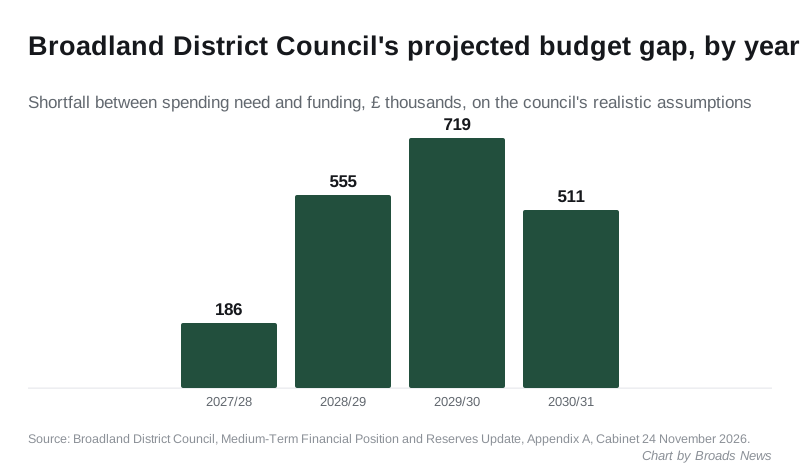
A second report sets out the council’s forecasts for the next four years (Medium-Term Financial Position and Reserves Update). On its “realistic” assumptions, spending will run ahead of funding every year:
| Year | Projected gap |
|---|---|
| 2027/28 | £186,000 |
| 2028/29 | £555,000 |
| 2029/30 | £719,000 |
| 2030/31 | £511,000 |
The report says the council’s core spending power, excluding specific grants, falls by about £0.5 million next year, with no allowance for inflation in 2028/29. Those projections already assume the maximum council tax rise allowed each year.
The council expects its transformation plan to close much of the gap. The areas it names include:
- greater use of AI and automation in customer services and productivity
- a different approach to managing its property
- shared operating models with other bodies
- reducing homelessness demand through prevention and early help
It pencils in £225,000 a year of savings from the plan from 2028/29. The report says some of the benefits are still “indicative or are still in discovery”.
Reserves
The council held £26.5 million in usable reserves at 31 March 2026. The report calls that a “robust” starting position, “although the majority of reserves are already allocated for specific projects”.
Of the £10.2 million general reserve:
- £1.5 million is the minimum prudent balance
- £3.8 million is already set aside for the capital programme
- £4.8 million is a buffer that can be used for any purpose
Cabinet is asked to move the £3.839 million into the capital funding reserve, to match the decision it made in February.
What it means for you
Nothing changes for residents yet. The overspend is small against the budget, and the council can cover it from reserves.
The figures matter for next year’s budget. The gaps above already assume the largest council tax rise allowed, so closing them will depend on savings. If you are waiting for a home adaptation funded by a Disabled Facilities Grant, ask the council about timing: it expects to spend £200,000 less on those grants this year than it planned.
Cabinet meets at 6pm on Tuesday 24 November. The papers are on the council’s meetings website.
Have your say